


How to Choose the Right Thickness Based on Work
Knitted Gloves (Cut-Resistant, General-Purpose Gloves) - Indicated by "Gauge"
"Gauge" (needle count) refers to the number of needles used on a one-inch (approximately 2.54 cm) knitting bed.
Core Concept:The higher the gauge, the finer the yarn, and the thinner, softer, and more sensitive the knitted gloves will be. Conversely, the lower the gauge, the thicker, warmer, and more durable the gloves will be.
How to Distinguish:
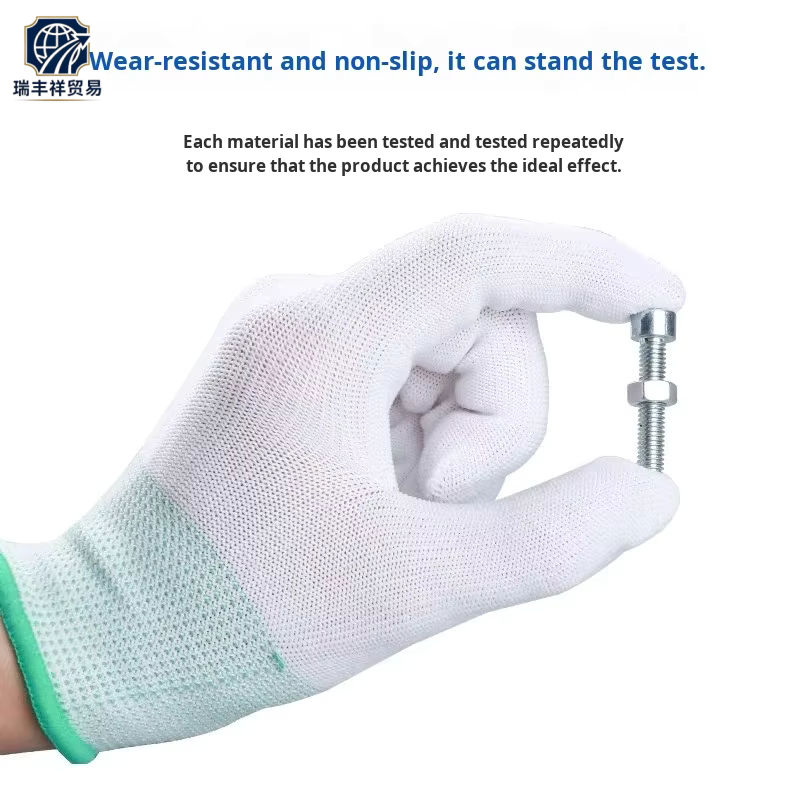
High Gauge (Thin Type): 13G, 15G, 18G
Characteristics:Extremely thin, breathable, and sensitive, suitable for fine operations.
Applications:Electronics industry, precision instrument assembly.
Medium Gauge (General-Purpose Type): 10G, 12G
Characteristics:Balances sensitivity, comfort, and basic protection.
Applications: General industry, logistics, light-duty cut-resistant.
Low Gauge (Thick Type): 7G, 8G
Characteristics:Heavy, warm, and very durable, with typically stronger cut resistance (due to thicker yarn).
Applications:Construction, outdoor work, heavy-duty cut-resistant.
How to Choose the Right Thickness Based on Work?
For extremely high flexibility and touch sensitivity (such as assembling small parts), choose:
High gauge (15G and above) knitted gloves, or ultra-thin (<0.2mm) PU/nitrile-coated gloves.
For general industrial applications (such as logistics, packaging, assembly), choose:
Medium gauge (10G-13G) knitted gloves, or standard (0.2mm-0.35mm) nitrile/PU-coated gloves.
For heavy-duty work (such as construction, metalworking, auto repair), choose:
Low gauge (7G-8G) gloves, or medium to heavy-duty (>0.36mm) nitrile-coated gloves.
For wet or oily environments, choose:
Medium thickness (0.3mm-0.5mm) nitrile-coated gloves, which offer good grip and oil resistance.



Please first Loginlater ~